

A WSA lets Canadian employers reimburse employees for fitness, mental wellness, and lifestyle expenses that are not covered by a provincial health plan or HSA.
Learn how it works, eligible expenses, and tax rules.
Trusted by 37,200+ Canadian Employers & Employees
If you already offer a Health Spending Account, you know it covers what the CRA defines as eligible medical expenses (prescriptions, dental, vision, paramedical services). But it doesn’t cover the gym membership your employee uses to manage their stress, the meditation app that helps them sleep, or the running shoes that keep them active outside of work.
That’s the gap a Wellness Spending Account fills.
A Wellness Spending Account (WSA) is an employer-funded benefit that gives employees a set annual allowance to spend on health and wellness expenses that aren’t covered by a traditional Health Spending Account or provincial health plan.
Unlike an HSA, where the Canada Revenue Agency dictates exactly which expenses qualify, a WSA is not regulated by the CRA. That means employers have full control over which categories of spending they want to support. Most WSA plans cover expenses related to physical fitness, mental wellness, nutrition, and personal development.
Because a WSA is employer-defined rather than CRA-regulated, you set the eligible categories, the annual allowance amount, and the claims process, giving you full control over how the benefit is used.
The result is a benefit that feels personal to every employee on your team, without requiring you to manage multiple programmes.
This is the most common question employers ask, and the distinction is straightforward.

An HSA reimburses employees for CRA-approved medical expenses (things like prescription drugs, dental work, physiotherapy, and vision care). Because these are recognised medical expenses, HSA reimbursements are tax-free for the employee.
A WSA reimburses employees for wellness expenses that the CRA does not classify as medical (gym memberships, fitness equipment, mindfulness apps, sports league fees, and similar).
Because these fall outside CRA guidelines, WSA reimbursements are treated as a taxable benefit and reported on the employee’s T4 slip .
Here’s what that means in practice:
Most Quikcard clients start with an HSA and add a WSA once they see the value of giving employees more choice. The two accounts work side by side on the same platform, with one card and one claims process.

Because WSAs are not governed by the CRA, there is no single universal list. Each employer works with their WSA provider to define which categories are covered.
That said, most Canadian WSA plans include expenses across these areas:
Gym and fitness club memberships, personal training sessions, fitness classes (yoga, pilates, spin, martial arts), sports league registration fees, recreational activity passes (ski lift tickets, climbing gym passes), fitness equipment and wearables, and athletic footwear.
Counselling and therapy services (beyond what your HSA covers), meditation and mindfulness app subscriptions, stress management courses, and resilience or coaching programmes.
Nutritional counselling and registered dietitian services, weight management programmes, and meal planning services.
Professional development courses, financial planning services, and ergonomic home office equipment.
The flexibility is the point. A 25-year-old on your team might use their WSA for a CrossFit membership. A working parent might put it towards a meditation app and a standing desk. Both get value from the same benefit, at the same cost to you.
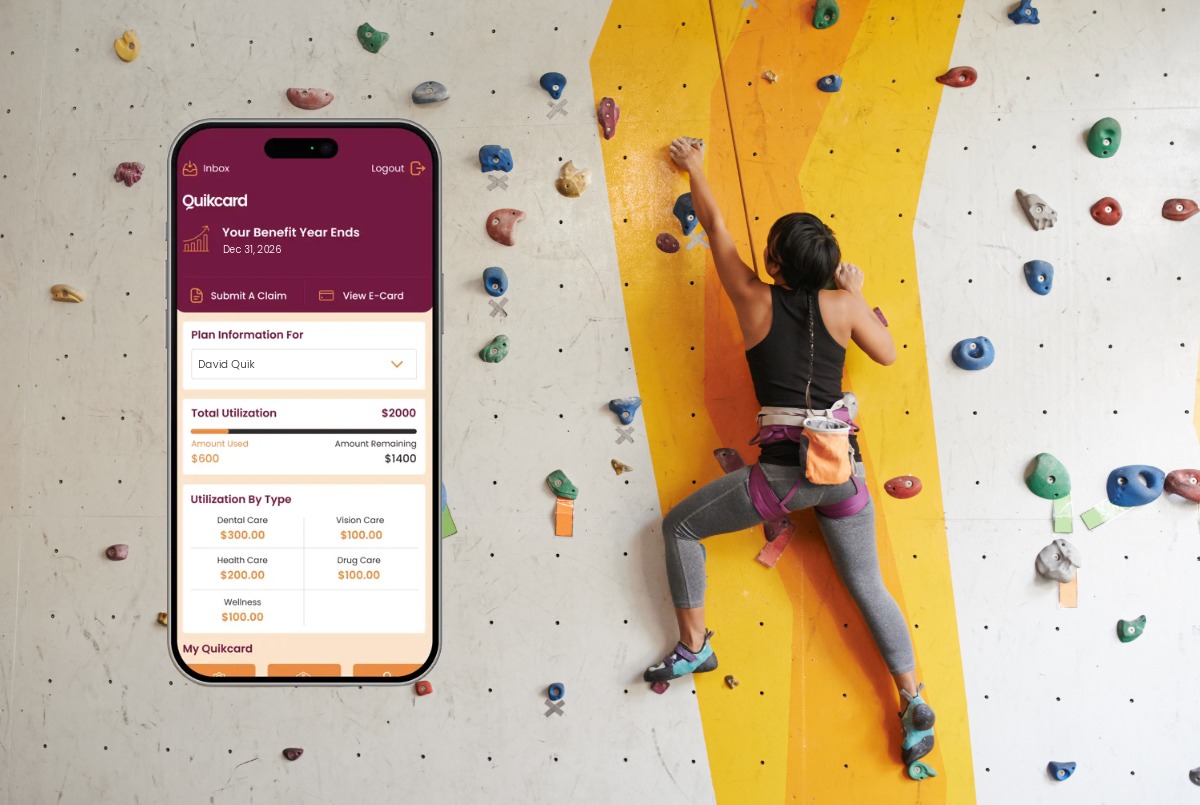
With Quikcard, you select the categories that align with your company culture and budget, and employees submit claims through the app or online portal for reimbursement.

The Mental Health Commission of Canada estimates that mental health problems cost the Canadian economy over $50 billion annually, with approximately 30% of all short- and long-term disability claims attributed to mental health conditions. For small and mid-sized businesses, the downstream effects show up as absenteeism, presenteeism, and turnover, all of which carry real costs.
Wellness spending accounts address this proactively. Research consistently shows that organisations with comprehensive wellness programmes see a 14–19% reduction in absenteeism. A Harvard Business Review meta-analysis found that medical costs fall by approximately $3.27 for every $1 spent on wellness programmes, with absenteeism costs falling by $2.73 per dollar invested.
You may not have the budget for traditional group insurance, but you still need to compete for talent. A WSA gives you a modern, flexible benefit at a price point you control (no premiums, no minimums, no insurer negotiations).
You set the annual allowance per employee, and that’s your total cost.
You likely already offer health and dental coverage, and your HR team knows that basic coverage is table stakes. A WSA is the differentiator. It signals that you care about the whole person, not just their dental claims.
In a market where nearly 4 in 10 Canadian employees say their employer doesn’t prioritise mental health, that signal matters for retention.
Unlike traditional wellness programmes — where employers have to source, negotiate, and manage multiple vendors for gym discounts, EAP bolt-ons, and wellness stipends — a WSA bundles everything into one account.
You define the categories, employees choose how to spend, and claims are handled digitally. No vendor management. No administrative overhead.

Quikcard delivers WSA benefits through a digital-first platform built for simplicity:
1. You set the plan.
Choose an annual WSA allowance per employee (or per employee class — you can tier it by role, seniority, or team). Define which expense categories are eligible.
2. Employees spend on wellness.
They pay for eligible expenses out of pocket (a gym membership, a pair of running shoes, a counselling session) and keep the receipt.
3. Claims are submitted digitally.
Employees submit claims through the Quikcard member app or online portal. No paper forms.
4. Reimbursement is processed.
Approved claims are reimbursed and the amount is reported as a taxable benefit on the employee’s T4 at year-end.
If you already use Quikcard for your HSA, adding a WSA is seamless; your employees use the same app, the same login, and the same card.
One platform, complete coverage.
This is important to get right, because HSAs and WSAs are treated differently under Canadian tax law.
Contributions to a WSA are tax-deductible as a business expense, just like HSA contributions. The difference is purely on the employee side.
WSA reimbursements are a taxable benefit. The amount claimed is added to the employee’s taxable income for the year and reported on their T4 slip. Importantly, employees are only taxed on amounts they actually use — unused WSA funds do not count as taxable income.
Because the CRA does not classify wellness expenses (gym memberships, fitness gear, wellness apps) as eligible medical expenses, these reimbursements cannot be made tax-free the way HSA reimbursements can.
The trade-off is flexibility, because WSA expenses aren’t CRA-regulated, employers have complete control over what’s covered. Many employers offset the taxable nature by setting WSA allowances slightly higher than they would for an HSA, so employees still receive meaningful value after tax.
Note: Tax treatment may vary depending on your specific plan structure and province. Consult a tax professional for guidance specific to your organisation.
Your HSA covers what your employees need when they’re unwell. A WSA supports what keeps them well in the first place (the gym membership, the counselling session, the standing desk, the running shoes).
Together, they give your team a complete, flexible benefits package — without the complexity or cost of traditional group insurance.
This Wellness Spending Account Canada guide has been reviewed and fact checked by:
Eligible expenses are determined by the employer and the WSA provider — not by the CRA.
Common categories include gym memberships, fitness classes, sports equipment, mental health apps, nutritional counselling, personal training, recreational activity fees, ergonomic equipment, and professional development courses. Quikcard works with you to define the categories that make sense for your team and budget.
Yes. Unlike a Health Spending Account (which is tax-free), WSA reimbursements are treated as a taxable benefit under CRA rules. The reimbursed amount is reported on the employee’s T4 slip and added to their taxable income.
However, employees are only taxed on amounts they actually claim — unused WSA funds are not taxed. Employer contributions remain tax-deductible as a business expense.
An HSA covers CRA-approved medical expenses (prescriptions, dental, vision, paramedical) on a tax-free basis.
A WSA covers lifestyle wellness expenses (fitness, mental wellness, nutrition, personal development) on a taxable basis.
The HSA is regulated by the CRA; the WSA is not, which gives employers more flexibility to define what’s covered. Most employers offer both to provide comprehensive coverage.
Yes, and this is the most common approach.
An HSA handles the medical side tax-free, while a WSA handles the wellness side with full flexibility.
On the Quikcard platform, both accounts are managed through the same app and card, so employees experience one seamless benefit rather than two separate programmes.
See Quikcard’s Flexible Spending Account options.
Employees pay for eligible wellness expenses out of pocket, then submit a claim with their receipt through the Quikcard member app or online portal. Approved claims are reimbursed directly.
If you already use Quikcard for your HSA, the WSA runs on the same platform — same login, same card, same experience.
There are no premiums or setup fees with a typical WSA. You set the annual allowance per employee. That’s your cost.
Most small businesses allocate between $300 and $1,500 per employee per year, depending on their budget and what else they offer. You only pay for what employees actually claim.
Yes. Unlike an HSA, where the CRA dictates the eligible expense list, a WSA is fully customisable.
You choose which categories to include.
For example, you might cover fitness and mental wellness but exclude personal development. Quikcard provides a standard list of eligible categories and works with you to tailor it.
This depends on how you structure the plan. Some employers allow unused funds to carry over to the next benefit year; others set a use-it-or-lose-it policy.
Quikcard can configure your WSA either way. Unused funds are not taxed to the employee regardless of the policy you choose.

17010 103 Avenue NW
200 Quikcard Centre
Edmonton, Alberta T5S 1K7
Ph: +1.780.426.7526
TF: +1.800.232.1997
F: +1.780.426.7581
© 2025 Quikcard


17010 103 Avenue NW
200 Quikcard Centre
Edmonton, Alberta T5S 1K7
Ph: +1.780.426.7526
TF: +1.800.232.1997
F: +1.780.426.7581
© 2026 Quikcard