

Same benefits budget. More employee satisfaction.
A flex spending account combines health and wellness into one allocation — your employees choose the split, you control the total cost.
Trusted by 37,200+ Canadian Employers & Employees
A flex spending account (FSA) in Canada combines a Health Spending Account (HSA) and a Wellness Spending Account (WSA) into a single, employer-funded benefit.
Health Spending Accounts (HSA) cover eligible healthcare expenses like dental, vision, and prescriptions. These funds are non-taxable.
Wellness Spending Accounts (WSA) cover lifestyle and wellness-related costs such as gym memberships, mental health services, and more. This portion is taxable.

Instead of running two separate accounts with two sets of rules, Flex Spending Accounts (FSA) let employees decide how to divide one allocation between health and wellness each year.
This means no category limits, no frequency restrictions, and no guessing which account covers what. Staff can tailor their plan to their individual needs within the boundaries their employer sets up each year.
Quikcard’s FlexPlan gives Canadian businesses of every size a benefits solution that’s simple to administer, compliant with Canada Revenue Agency (CRA) guidelines, and flexible enough to attract and retain top talent.
A flex spending account in Canada is an employer-funded benefits plan that rolls two distinct accounts (an HSA and a WSA) into one combined allocation. The employer sets a total annual benefit amount per employee.
Employees then decide, during a 30-day annual enrollment window, how much of that allocation goes toward health expenses and how much goes toward wellness.
This is different from the USA’s concept of an FSA, which involves employee salary deferrals and is governed by IRS rules. In Canada, there are no government-imposed contribution caps. The employer controls the total allocation, and the CRA determines which expenses qualify under each component.
This is different from the USA’s concept of an FSA, which involves employee salary deferrals and is governed by IRS rules. In Canada, there are no government-imposed contribution caps. The employer controls the total allocation, and the CRA determines which expenses qualify under each component.
The result is a benefits plan that feels personalised to every employee on the team — without requiring the employer to design dozens of coverage tiers or negotiate with an insurance carrier.
There are two major employee benefits frustrations that FSAs resolve for Canadian employers.

The most common frustration with standalone HSA and WSA plans isn’t cost — it’s utilisation. Employers fund the accounts, but employees often underuse them because they don’t fully understand the different rules for each.
An HSA covers CRA-eligible medical expenses and is non-taxable. A WSA covers employer-defined wellness expenses and is taxable. Each has its own eligible expense list, its own claim process, and its own reporting requirements.
The complexity creates hesitation for employees and wasted spend for employers.
The second problem is fit.
A standalone HSA works well for the employee with recurring dental bills, but does nothing for the employee who’d benefit most from a gym membership or mental health counselling. A standalone WSA addresses that gap, but at the expense of tax-free health coverage.
With separate accounts, the employer has to guess the right dollar split for the entire team — and that guess will be wrong for a meaningful portion of employees.
The most common frustration with standalone HSA and WSA plans isn’t cost. It’s utilisation! Employers fund the accounts, but employees often underuse them because they don’t fully understand the different rules for each.
An HSA covers CRA-eligible medical expenses and is non-taxable. A WSA covers employer-defined wellness expenses and is taxable. Each has its own eligible expense list, its own claim process, and its own reporting requirements.
The complexity creates hesitation for employees and wasted spend for employers.
The second problem is fit. A standalone HSA works well for the employee with recurring dental bills, but does nothing for the employee who’d benefit most from a gym membership or mental health counselling.
A standalone WSA addresses that gap, but at the expense of tax-free health coverage.
With separate accounts, the employer has to guess the right dollar split for the entire team; that guess will be wrong for a meaningful portion of employees.
A flex spending account eliminates both problems. Employees get one allocation and choose their own HSA/WSA split during annual enrollment, within boundaries the employer sets.
The result is higher utilisation (because employees direct dollars where they’ll actually use them), stronger perceived value (because every employee gets a plan that fits their life), and simpler administration (because everything runs through one provider, one card, one reporting workflow).
For employers, the total cost stays fixed and remains 100% tax-deductible as a business expense, regardless of how employees split their allocation.

All three are Quikcard products. The question is which structure fits your team best.
| Feature | Health Spending Account (HSA) | Wellness Spending Account (WSA) | Flexible Spending Account (FSA / FlexPlan) |
|---|---|---|---|
| What it covers | CRA-eligible medical, dental, vision, and paramedical expenses | Employer-defined wellness and lifestyle expenses | Both — employees choose their split |
| Tax treatment for the employee | Non-taxable benefit | Taxable benefit (reported on T4) | HSA portion non-taxable; WSA portion taxable |
| Tax treatment for the employer | 100% deductible business expense | 100% deductible business expense | 100% deductible business expense |
| Carry-forward of unused funds | Yes — available with Quikcard HSA plans | Not available (see note below) | Not available (see note below) |
| Employee choice in allocation | No — employer sets the HSA amount | No — employer sets the WSA amount | Yes — employees allocate between HSA and WSA during annual enrollment |
| Category or frequency limits | Can be set by employer | Can be set by employer | None — no per-category caps |
| Best suited for | Employers who want to focus on core health coverage | Employers who want to promote wellness culture | Employers who want maximum flexibility and employee autonomy |

Employer contributions to either the HSA or WSA side of a FlexPlan are fully deductible as a business expense. This applies regardless of how employees split their allocation.
Employee reimbursements from the HSA portion are received tax-free. This is because HSA-eligible expenses fall under the CRA’s definition of a Private Health Services Plan (PHSP), which is not considered a taxable benefit. Employees receive full value for every dollar spent on eligible health costs.
Employee reimbursements from the WSA portion are treated as a taxable benefit. The amount is reported on the employee’s T4 slip and included in their taxable income for the year. Despite the tax, WSA dollars still represent significant value — employees use pre-allocated employer funds rather than after-tax personal income to cover wellness expenses.
Consider an employer who allocates $2,500 per employee per year to a FlexPlan.
The employer’s cost is identical either way, and the full $2,500 per employee is deductible as a business expense.
For employers evaluating the cost-effectiveness of a FlexPlan, the combined structure often delivers a stronger perceived benefit per dollar than either account alone, because employees can direct their allocation to whichever category delivers the most personal value.
A FlexPlan covers two categories of expenses: CRA-eligible health expenses (through the HSA component) and employer-defined wellness expenses (through the WSA component).
The HSA portion covers expenses that qualify as medical expenses under the CRA’s guidelines for Private Health Services Plans. Common eligible expenses include:
This is not an exhaustive list. The CRA maintains a comprehensive list of eligible medical expenses, and Quikcard’s team can help clarify coverage for specific situations.
The employer defines which WSA expenses are eligible when designing their FlexPlan, giving them full control over the scope of coverage.

Setting up a FlexPlan with Quikcard is straightforward. The employer determines the total annual benefit allocation per employee, defines which WSA expenses are eligible, and selects whether to set any boundaries on how employees can split their allocation (for example, requiring a minimum HSA or WSA percentage).
Quikcard handles implementation, employee communication, and ongoing administration. Employers access a secure portal for enrollment management, reporting, and tax documentation. Annual reports are generated automatically for plan administrators to support T4 compliance.
Employees choose their HSA/WSA split during a 30-day annual enrollment period. If an employee doesn’t make a selection, a default allocation set by the plan administrator applies — so every employee is covered regardless.
Once enrolled, employees can use their benefits in three ways:
There are no per-category frequency limits or dollar caps within either the HSA or WSA allocation. Employees have full autonomy over how they spend within each component.
If you’re a business owner making benefits decisions directly, the last thing you need is two separate accounts to set up, fund, and explain to your team. With a small team, every employee’s needs are different; one person wants orthodontics for their kid, another wants a gym membership, and a third just needs prescription coverage.
A FlexPlan lets you set one total allocation and let each employee direct their dollars where it matters most to them.
Your total cost is fixed.
You choose the annual allocation and that’s your commitment. There’s no insurance carrier to negotiate with, no underwriting, and no claims adjudication on your end.
Quikcard handles the administration, and your employees get a single card and app instead of navigating two separate accounts with different rules.
If you’re an HR manager or VP evaluating benefits options, you’re likely dealing with a workforce that has genuinely different needs — and a benefits plan that can’t flex to match.
Standalone HSA and WSA accounts mean two enrollment workflows, two sets of eligible expense rules to communicate, and separate T4 reporting for the taxable WSA component. A FlexPlan consolidates all of that into one plan, one enrollment period, and one reporting stream.
When employees choose their own HSA/WSA split, utilisation goes up because they’re spending on things they actually need. That translates into stronger perceived value — a meaningful factor when you’re competing for talent against companies offering fully insured group plans with higher sticker prices. Quikcard generates the documentation your payroll team needs for T4 reporting, and the FlexPlan structure scales with you — the same framework works whether you have 25 or 75 people on it.
A common concern for growing businesses is whether a flex spending account can replace a traditional group insurance plan entirely. The answer depends on your team’s needs. A FlexPlan excels at covering the broad range of day-to-day health and wellness expenses that employees actually use. However, it does not include catastrophic or high-cost coverage like long-term disability or critical illness insurance.
Many employers use a FlexPlan alongside a base insurance plan — the insurance covers the high-cost, low-frequency events, while the FlexPlan handles everything else with greater flexibility and lower administrative burden. Quikcard’s team can help you evaluate the right combination for your organisation.
A flex spending account doesn’t just cover health and wellness. It lets employees decide what matters most to them.
That’s the kind of benefit that keeps people around.
Quikcard’s FlexPlan is available with fast setup, award-winning support, and over 35 years of experience administering Canadian health benefits.
Whether you’re a five-person startup or a 75-person company ready to level up your benefits, we’ll design a plan that fits.
This Flexible Spending Account Canada guide has been reviewed and fact checked by:
A traditional group benefits plan is an insurance product with fixed coverage categories, per-category limits, and premiums that can fluctuate year to year based on claims history.
A flex spending account is an employer-funded allocation with no insurance carrier involved. The employer controls the total cost, employees control how they spend it, and there are no premium increases tied to utilisation. Both can be used together; some employers layer a FlexPlan on top of a base insurance plan to extend coverage.
There are no government-imposed contribution limits for flex spending accounts in Canada. The employer sets the total annual allocation per employee based on their budget and benefits strategy. Quikcard works with employers to determine an appropriate allocation level during plan design.
Yes. The HSA portion of a FlexPlan can be used to cover eligible expenses for an employee’s dependants as defined by the CRA. Whether the WSA portion extends to dependants is determined by the employer’s plan design.
If an employee doesn’t make a selection during the 30-day annual enrollment window, the default allocation set by the plan administrator is applied automatically. This ensures every employee has active coverage from day one of the plan year.
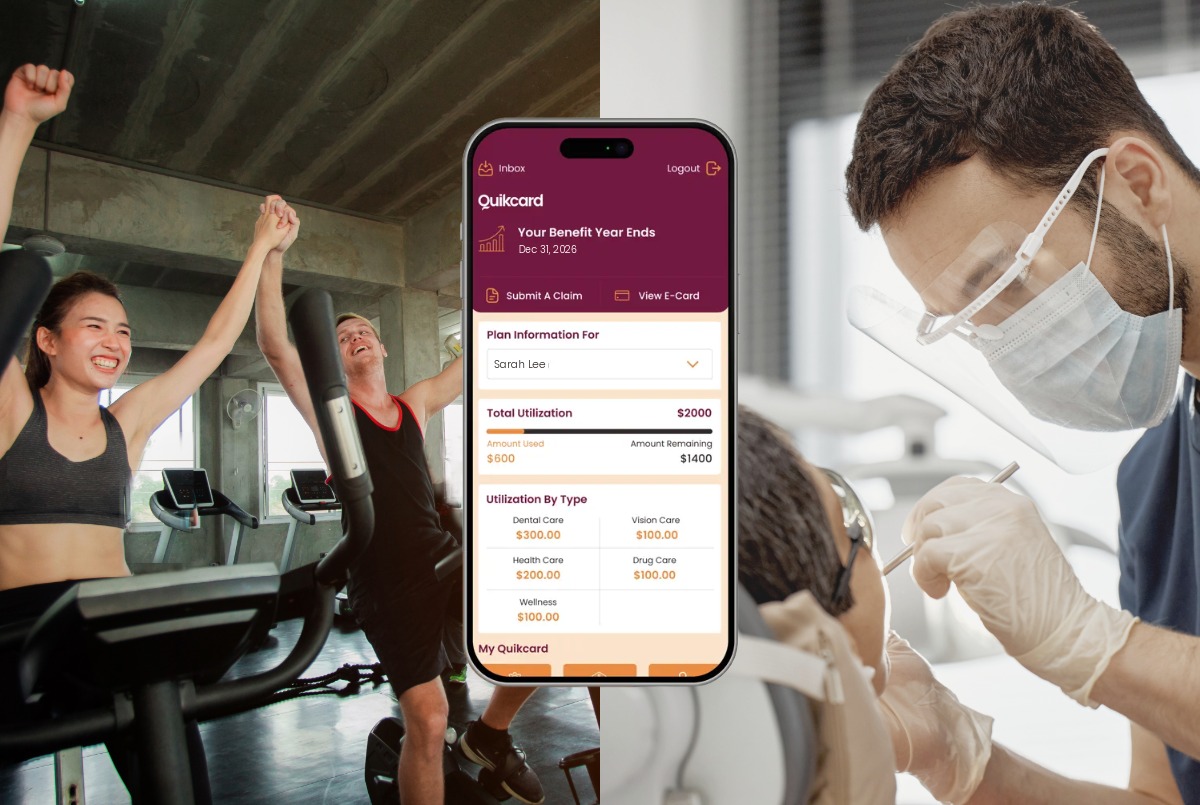
Employees can submit claims in three ways: using the Quikcard benefits card at a network provider (no out-of-pocket payment required), uploading receipt photos through the Quikcard mobile app, or submitting documentation via email or the online portal. Once approved, reimbursements are processed as per the employer’s benefit plan terms.
Unlike traditional group plans, a FlexPlan has no frequency restrictions or per-category dollar limits. There is no cap on how much can go toward a specific benefit category — such as a $500 limit for massage only. Employees allocate their total benefit dollars however they choose within the HSA and WSA components.
Yes. FlexPlan can be implemented by employers across different industries in Canada, including private, public, and non-profit organisations. The plan is customisable to suit the needs of both small businesses and larger organisations.
Yes. Current Quikcard HSA customers can transition to a FlexPlan. Moving to a FlexPlan may require simplifying your current plan structure. Your plan administrator can contact our team and we’ll review your existing coverage and advise on next steps.

17010 103 Avenue NW
200 Quikcard Centre
Edmonton, Alberta T5S 1K7
Ph: +1.780.426.7526
TF: +1.800.232.1997
F: +1.780.426.7581
© 2025 Quikcard


17010 103 Avenue NW
200 Quikcard Centre
Edmonton, Alberta T5S 1K7
Ph: +1.780.426.7526
TF: +1.800.232.1997
F: +1.780.426.7581
© 2026 Quikcard