
Health Spending Accounts (HSA) Canada: The 2026 Guide for Employers & Businesses

A complete guide to tax-free employee benefits, eligibility, and how Canadian HSAs work for employers.

Skip to Section

Did you know that 40% of Canadian employers now offer Health Spending Accounts to employees? That’s a 10% jump over the last decade.

This post will guide you through Canadian Health Spending Accounts and show you how it can save your organisation in taxes and exorbitant health insurance hikes.

What Are Health Spending Accounts (HSA) in Canada?

A Health Spending Account (HSA) is an employer-funded benefit plan that reimburses employees for eligible medical expenses on a completely tax-free basis. The employer allocates a set dollar amount for each employee, and employees use those funds to pay for the health care services that matter most to them.

Employers can decide how they want to build the plan but all items that are eligible under the specific plan design must be eligible under Canada Revenue Agency (CRA) guidelines. Examples would be the employer may only opt into dental and vision but leave out health services, so the employee cannot submit a health claim if the plan is not built to have it in place.

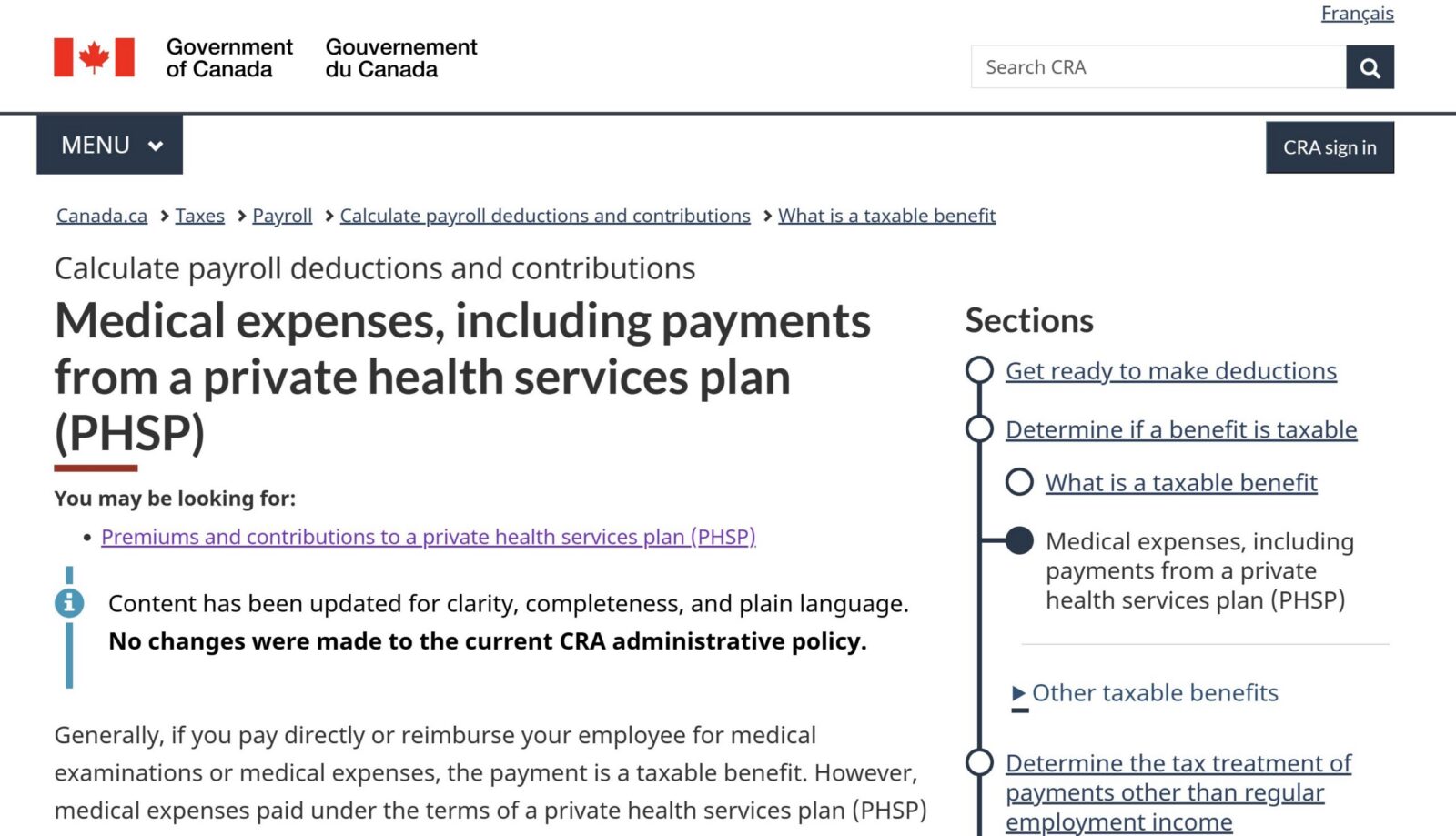
In Canada, HSAs are structured as a Private Health Services Plan (PHSP) under the Income Tax Act. This means employer contributions are fully tax-deductible and employee reimbursements are not considered taxable income.

Note: Health Spending Accounts are also referred to as Health Care Spending Accounts (HCSAs); the terms are used interchangeably.

Health spending Accounts aren’t health insurance.

Unlike traditional group insurance plans, an HSA does not require medical questionnaires, has no waiting periods for pre-existing conditions, and gives both employers and employees significantly more control over how benefits dollars are spent.

There are no co-pays, no deductibles, and no insurer deciding what gets covered — if the expense is on the Canada Revenue Agency’s (CRA) list of eligible medical expenses, it qualifies.

There are also no premiums associated with Health Spending Accounts. Employers only get charged on what’s used.

Two distinct groups of legal entities can set up an HSA. Whether you have two employees or 80, an HSA can be tailored to fit your team and your budget.

1. Any incorporated business in Canada can establish an HSA for its employees. 

This includes professional corporations, owner-operated companies, and small businesses.

2. Sole proprietors can also set one up, if they have at least one arm’s-length employee.

This means if your business is unincorporated, only employees who aren’t family can get covered.

How are HSAs in Canada Different From Group Insurance?

Health spending Accounts aren't insurance

Unlike traditional group insurance plans, an HSA does not require medical questionnaires, has no waiting periods for pre-existing conditions, and gives both employers and employees significantly more control over how benefits dollars are spent.

There are no co-pays, no deductibles, and no insurer deciding what gets covered — if the expense is on the Canada Revenue Agency’s (CRA) list of eligible medical expenses, it qualifies. 

There are also no premiums associated with Health Spending Accounts. Employers only get charged on what’s used.

Who can set up an HSA in Canada?​

2 types of Legal entities can set up an HSA

Whether you have two employees or 80, an HSA can be tailored to fit your team and your budget.

1. Any incorporated business in Canada can establish an HSA for its employees. 

This includes professional corporations, owner-operated companies, and small businesses. 

2. A sole proprietorship can also set one up, if they have at least one arm’s-length employee.

This means if your business is unincorporated, only employees who aren’t family can get covered.

How Do Health Spending Accounts Work?

The mechanics of an HSA are straightforward. The employer chooses a provider, decides how much to contribute per employee, and the provider handles claims administration. Employees then access their funds whenever they need to pay for eligible health care.

HSA for Canadian Employers and Business Owners

As the employer, you set the rules. You decide how much to allocate per employee — and you can set different amounts for different employee classes (for example, management versus staff).

Here is how the process works:

  1. Open an HSA plan (aka. Private Health Services Plan) with a provider like Quikcard.
  2. Decide how much to contribute per employee per year.
  3. Make contributions to the account — you are only charged when employees actually submit claims.
  4. Manage enrolment, funding, and reporting through a secure online portal.
  5. Claim employer contributions as a 100% tax-deductible business expense

Quikcard's Health Spending Accounts support direct billing at over 65,000 healthcare providers across CanadaFrom the employee’s perspective, the experience is simple:

  1. Receive a health service — a dental check-up, physiotherapy session, new prescription glasses, or any other eligible expense.
  2. Use direct billing where available (Quikcard has over 65,000+ healthcare providers across Canada) or pay out of pocket
  3. If you pay out of pocket, submit a claim through the provider’s online portal or mobile app, attaching the receipt.
  4. Then, get reimbursed — completely tax-free.

For Employers​

Canadian businesses & organisations

As the employer, you set the rules. You decide how much to allocate per employee — and you can set different amounts for different employee classes (for example, management versus staff).

Here is how the process works:

  1. Open an HSA plan (aka. Private Health Services Plan) with a provider like Quikcard.
  2. Decide how much to contribute per employee per year.
  3. Make contributions to the account — you are only charged when employees actually submit claims.
  4. Manage enrolment, funding, and reporting through a secure online portal.
  5. Claim employer contributions as a 100% tax-deductible business expense

For Employees

staff (full-time, part-time)

From the employee’s perspective, the experience is simple:

  1. Receive a health service — a dental check-up, physiotherapy session, new prescription glasses, or any other eligible expense.
  2. Use direct billing where available (Quikcard has over 65,000+ healthcare providers across Canada) or pay out of pocket
  3. If you pay out of pocket, submit a claim through the provider’s online portal or mobile app, attaching the receipt.
  4. Then, get reimbursed — completely tax-free.
Bill Brown
If I could click on 10 stars, I absolutely would. I have been a client of Quikcard for approx. 4 years now and this company has got to be the best there is in the business. Every time I call and ask a question, someone (real) is there to answer it and I don't have to wait an hour on hold just to be told there is a high volume of calls etc. They know how to do business and they know how to do health benefits
Terry Elkins
Working with Quikcard has been an awesome experience. The setup was quick and easy, the products were exactly what we were looking for, and the customer service agent (a real person!!!) was friendly and incredibly helpful. Would I recommend Quikcard? Absolutely, no hesitation.

HSA Tax Benefits for Canadian Employers​

The tax advantages of an HSA (or Private Health Services Plan) are one of the primary reasons Canadian businesses choose this benefit structure. 

An HSA delivers a double tax benefit that traditional benefits plans cannot match:

  • Employer contributions are 100% tax-deductible as a legitimate business expense.
  • Employee reimbursements are 100% tax-free — they do not appear on the employee’s T4 slip and are not considered taxable employment income.

Important note for Quebec: In the province of Quebec, HSA benefits are considered a taxable benefit for provincial income tax purposes. This does not apply in any other province or territory.

HSA provides significantly greater tax efficiency.

Some business owners wonder whether they should simply claim health expenses as a personal Medical Expense Tax Credit (METC) on their tax return. 

In almost every case, an HSA provides significantly greater tax efficiency.

With the METC, you receive a partial tax credit on expenses that exceed a threshold.

With an HSA, the full expense is deducted at the corporate level, and the employee receives full reimbursement tax-free.

The difference can amount to 20–40% in additional savings, depending on your tax bracket and province.

Consider a small business with five employees, each allocated $2,000 per year in HSA benefits. 

  • The total annual cost is $10,000 — and the entire amount is deductible against the company’s taxable income.
  • Meanwhile, each employee receives up to $2,000 in tax-free health care reimbursements.
  • No payroll taxes. No T4 implications. No complexity.

What Expenses Are Eligible Under a Canadian Health Spending Account?​

The Canada Revenue Agency (CRA) determines which expenses qualify for reimbursement through an HSA or Private Health Services Plan .

Any expense that meets the definition of an eligible medical expense under the Income Tax Act — specifically, those that would qualify for the Medical Expense Tax Credit (METC) — can be claimed.

This covers a broad range of health care services and products, including:

 HSA*Other
Acupuncture 
Assistive Mobility Device 
Audiologist Services & Hearing Aids 
Autism Treatments 
Cataract Surgery 
Chiropodist Services 
Chiropractic Services
Contact Lenses
Dental Hygienist Services 
Dental Technologist Services 
Prescription Drugs 
Elderly Parent & Department Care 
Fertility Drugs & Treatment Services 
Laser Eye Surgery 
Massage Therapist (RMT) 
Medical Laboratory Services 
Medical Radiation Treatment 
Midwife Services 
Naturopath Services 
Occupational Therapist Services 
Optician Services 
Optometrist Services 
Orthodontic Services 
Physiotherapist Services 
Prescription Sunglasses 
Psychologist Services 
Respiratory Therapists 

For the complete and most current list of eligible medical expenses, refer to the CRA’s Income Tax Folio S1–F1–C1, Medical Expense Tax Credit.

Ineligible expenses may instead be covered through WSA.

  • Cosmetic procedures (teeth whitening, Botox),
  • gym memberships,
  • fitness equipment,
  • nutritional supplements,
  • and services from non-licenced practitioners

These types of expenses are generally not eligible under an HSA. 

Note that eligible practitioner types can vary by province, so it is worth confirming coverage for specific services in your jurisdiction.

Ineligible expenses may be covered through a Wellness Spending Account (WSA).

HSA vs. Wellness Spending Account (WSA): What’s the Difference?

These two benefit types are often mentioned together, but they serve different purposes and operate under different tax rules. Understanding the distinction helps employers design a benefits package that truly meets their team’s needs.

FeatureHealth Spending Account (HSA)Wellness Spending Account (WSA)
Tax statusTax-free for employees; tax-deductible for employersTaxable benefit (added to employee’s T4 employment income)
Eligible expensesCRA-defined medical expenses (dental, vision, prescriptions, paramedical, etc.)Employer-defined wellness and lifestyle expenses (gym, fitness, personal development, etc.)
RegulationGoverned by the CRA under the Income Tax ActNot regulated by the CRA; employer sets the rules
Unused fundsMay roll over or be returned to employer (but can be set to expire for staff)May roll over or be returned to employer (but can be set to expire for staff)
Best forCovering medical costs and supplementing traditional benefitsPromoting overall wellness, mental health, and healthy lifestyle choices

Many Canadian employers offer both an HSA and a WSA as part of a combined benefits package, sometimes structured as a Flexible Spending Account (FSA) that lets employees allocate their dollars between the two. This approach provides the broadest coverage while maintaining cost control.

How to Set Up Health Spending Accounts in Canada

Setting up an HSA is significantly simpler than establishing a traditional group benefits plan. There are no medical questionnaires, no underwriting, and no minimum employee counts.

Here is what our process looks like:

Choosing a Health Spending Account Provider in Canada

When comparing HSA providers for your Canadian business, the key factors are rollover policy, claim processing speed, and customer support model.

Quikcard is one of the few Canadian HSA providers that returns unused funds to the employer at year-end rather than forfeiting them. For a business allocating $1,000 per employee, a 20% unused balance means $200 per employee returned rather than lost.

Quikcard operates a Canadian-based support team reachable by phone, processes most claims within 48 hours, and has no minimum employee count. For employers looking to offer both medical and wellness benefits, Quikcard’s FlexPlan FSA combines HSA and WSA into one account with one card.

Quikcard has been administering health spending accounts in Canada for over 35 years. Our award-winning service team answers calls in under two minutes.

When other providers rely on apps as their sole point of contact, Quikcard backs its technology with genuine human support. 

Check your HSA tax savings and get a quote

Who Should Consider an HSA?​

Jonathan Chia
Signed up with Quikcard to manage the health spending account for my small company. The process was seamless and simple to onboard both as an administrator and card holder. I had everything set up in 15 minutes! Customer service was excellent and they quickly answered any questions that I had.
Dave Ozubko
As a small business owner quick card has been a great benefit for our employees and family. It’s super easy to use and with FAST reimbursement. The team is also very informative and easy to access if you have any questions at all. Highly recommended.
Terry Elkins
Working with Quikcard has been an awesome experience. The setup was quick and easy, the products were exactly what we were looking for, and the customer service agent (a real person!!!) was friendly and incredibly helpful. Would I recommend Quikcard? Absolutely, no hesitation.

Health spending accounts are not limited to large companies with big budgets. In fact, 40% of Canadian employers now offer HSAs — a 10% increase since 2017.

They are one of the most practical benefit solutions for smaller organisations that want to offer meaningful health coverage without the complexity and unpredictable costs of traditional plans.

If you run a small business, you likely want to offer health benefits but may not have the budget for a full group plan.

An HSA lets you set a fixed amount per employee, keep your costs predictable, and provide your team with genuine, flexible health coverage. As an incorporated owner, you can also include yourself in the plan — making your own medical expenses fully deductible at the corporate level.

As a sole proprietorship, you can provide health-related employee benefits to arm-length staff, without insane premiums.

For mid-sized companies, an HSA works exceptionally well as a complement to an existing group benefits plan.

It can cover the gaps that traditional insurance leaves behind — expenses that exceed annual maximums, services not included in the group plan, or deductible amounts employees would otherwise pay out of pocket.

HR managers benefit from the administrative simplicity: one portal, clear reporting, and predictable costs.

Doctors, dentists, lawyers, accountants, and other incorporated professionals regularly use Health Spending Accounts to reimburse personal and family medical expenses through their corporation. 

This is often referred to as a “class of one” plan, and it is one of the most tax-efficient ways to manage health costs as a business owner in Canada.

A dental clinic with 8 employees allocates $1,500 per team member per year. The clinic’s total annual cost is $12,000 — fully tax-deductible. Hygienists use their funds for chiropractic and massage therapy, while front-desk staff put theirs toward prescription glasses and counselling. The owner, as an incorporated professional, claims her family’s orthodontic work through the same plan.

A growing tech company with 35 employees already has a traditional group benefits plan but adds an HSA to cover the gaps. Employees use their $1,000 HSA allocation to reimburse expenses their group plan does not cover — such as fertility treatments, naturopathic medicine, and the portion of dental work that exceeds their plan’s annual maximum. The HR manager appreciates the simplicity: one portal, one invoice, predictable costs.

A sole-practitioner law firm with one arm’s-length employee sets up a class-of-one HSA. The lawyer uses it to reimburse $3,000 per year in personal and family medical expenses — laser eye surgery, prescription medications, and their child’s dental braces — all deducted at the corporate tax rate instead of claimed as a personal Medical Expense Tax Credit.

Common Misconceptions About HSAs

Despite the growing adoption of HSAs across Canada, several myths continue to create hesitation among employers. 

Here are the most common misconceptions — and the reality behind each.

This is a common confusion with US-style health spending accounts. 

In Canada, HSA plans can be structured to allow unused credits to roll over into the following benefit year. 

Whether funds roll over or are returned to the employer depends on the plan design — and with Quikcard, you have the flexibility to choose whichever approach suits your business.

This is one of the most persistent myths. In reality, HSAs are among the most accessible benefit options for small businesses. 

There are no minimum employee requirements (beyond having at least one arm’s-length employee for sole proprietors), no minimum contribution thresholds, and no complex underwriting. 

A company with three employees can set up and administer an HSA just as easily as one with three hundred.

The opposite is true. Compared to traditional group insurance — which involves medical questionnaires, underwriting, annual renewals, and rate negotiations — an HSA is straightforward.

Setup typically takes days, not weeks. Ongoing administration is handled by the provider, and employers manage enrolment and contributions through a single online portal. With Quikcard, most employers spend less than 30 minutes per month on plan administration.

An HSA can serve as a standalone benefit, but it does not have to replace an existing group plan. 

Many employers use an HSA as a complement to their traditional coverage — filling in the gaps that group insurance leaves behind, such as expenses above annual maximums, services not covered under the plan, or deductible amounts. 

The two work well together, and offering both gives employees significantly more flexibility.

The range of eligible expenses under an HSA is far broader than most people expect.

Beyond the obvious categories like dental and prescriptions, HSAs cover fertility treatments, midwife services, hearing aids, orthotics, psychological counselling, laser eye surgery, and much more. 

The full list is defined by the CRA and includes hundreds of eligible medical expenses and practitioner types.

Advantages of an HSA for Canadian Businesses

Here is a summary of the key reasons Canadian employers choose health spending accounts:

  • Employer contributions are 100% tax-deductible as a business expense.
  • Employee reimbursements are 100% tax-free (except in Quebec for provincial tax purposes).
  • Unused funds can be returned to the employer — you only pay for what employees actually claim.
  • There are no expenses for the employer until a claim is made.
  • No sign-up fees, transaction fees, or medical questionnaires.
  • Employees choose how to use their eligible HSA credits, giving them real control over their health and well-being.
  • Employers benefit from healthier, happier, and more productive work environments.
  • Plans are fully customisable to fit businesses of all sizes.

Compared to traditional group insurance, an HSA eliminates the annual renewal negotiations, avoids premium increases driven by claims history, and removes the restrictions on which providers employees can see. 

It is one of the simplest, most cost-effective ways to deliver meaningful employee health benefits in Canada.

Ready to Offer Your Team Tax-Free Health Benefits?

Whether you are setting up your first employee benefits plan or looking to supplement an existing one, Quikcard Health Spending Accounts give your team real flexibility, meaningful coverage, and the support of a provider that has been trusted by Canadian businesses for over 35 years.

A. Dawn
Signing our group up for Quikcard’s new Flexible Spending Account (FSA) was one of the best decisions we’ve made. Our employees are thrilled with the added flexibility, and as a plan administrator, I appreciate how simple it is to manage. Highly recommend for any organization looking to modernize their benefits!
Dr. S. Sharma
After surveying our employees and really understanding what was important to them when it came to their health benefits, we decided to switch to Quickcard. The support and service from Chris and the Quickcard team has been beyond expectation.

No out-of-pocket at over 65,000+ healthcare providers

With Quikcard, direct billing is available for eligible dental, extended health, and prescription drug claims — so employees can skip the out-of-pocket step entirely for many common expenses.

Claims are processed within 48 hours, and electronic reimbursements are received the next business day.

This HSA Canada guide has been reviewed and fact checked by:

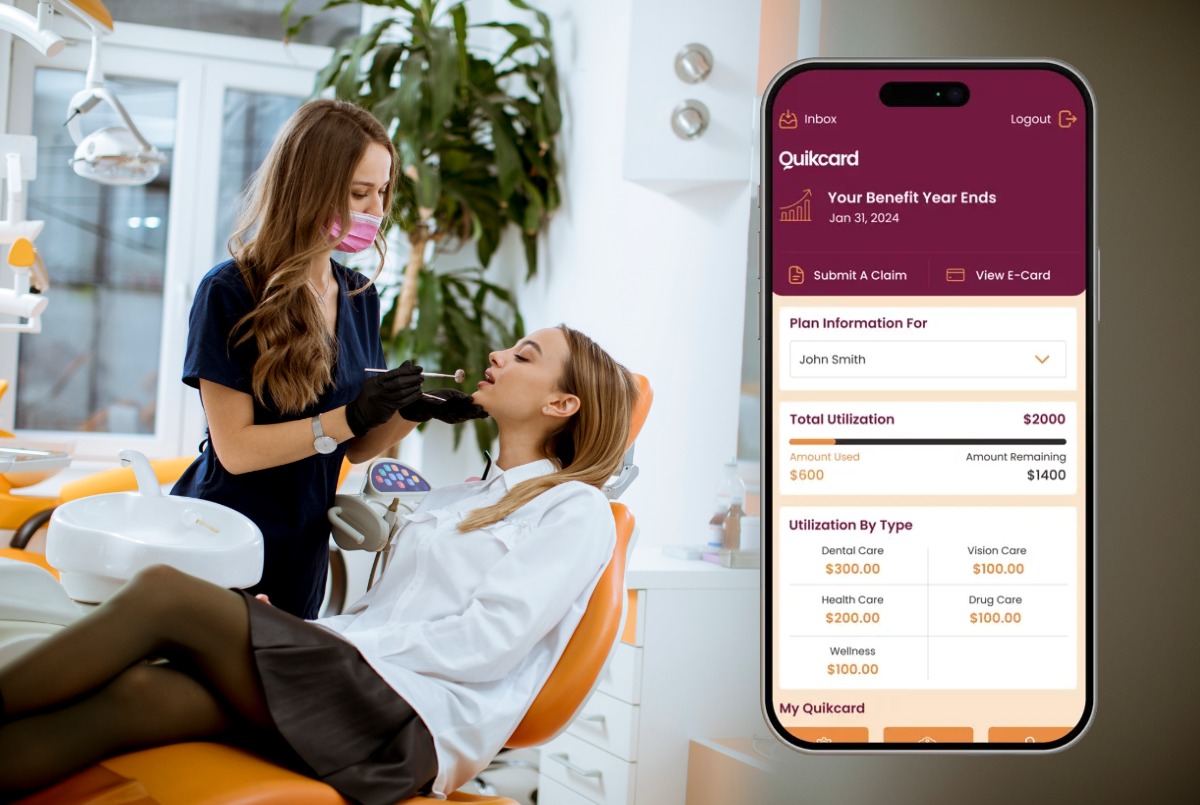
Let employees manage their Health Spending Accounts via the Quikcard app

Frequently Asked Questions
About Health Spending Accounts

A health spending account is an employer-funded benefit plan that reimburses employees for eligible medical expenses on a tax-free basis.

HSAs are structured as a Private Health Services Plan (PHSP) under Canada’s Income Tax Act, making employer contributions 100% tax-deductible and employee reimbursements non-taxable.

Yes. Health Spending Account (HSA) and Health Care Spending Account (HCSA) refer to the same type of benefit plan.

The terms are used interchangeably across the Canadian benefits industry. Both describe an employer-funded plan that reimburses CRA-eligible medical expenses tax-free.

Any medical expense that qualifies for the CRA’s Medical Expense Tax Credit (METC) is generally eligible under an HSA.

Common examples include dental care, prescription drugs, vision care, physiotherapy, chiropractic services, massage therapy, psychology, hearing aids, fertility treatments, and medical devices.

The CRA maintains the complete list in Income Tax Folio S1–F1–C1.

Expenses not listed as eligible by the CRA are considered ineligible.

Common examples of ineligible expenses include cosmetic procedures, gym memberships, health supplements, fitness equipment, and services from non-licenced or non-qualified medical practitioners.

With a Quikcard HSA, there are no sign-up fees or hidden costs. The plan only costs money when employees submit claims (typically 12% of claims amount).

All unused pre-payments can be returned to the company. The employer decides how much to allocate per employee, so costs are fully controllable and predictable.

Absolutely. Many Canadian employers use an HSA to supplement their existing group insurance plan.

The HSA can cover the gaps that traditional insurance leaves behind, such as expenses exceeding annual maximums, services not included in the group plan, or deductible amounts employees would otherwise pay out of pocket.

Setting up a Quikcard HSA is straightforward. Contact the Quikcard team by phone, website chat, or email.

A representative will help you design a plan structure, set contribution levels, and enrol your employees. There are no medical questionnaires or waiting periods. Most plans can be up and running within one business day.

Once your Quikcard HSA is set up, you can access your personal account online to check balances, submit claims, and search through a directory of providers.

Apple and Android users can also download the Quikcard App for on-the-go access.

Unless there is a forward date on your plan, you can submit a claim as soon as you are enrolled.

Quikcard offers direct billing through a network of over 65,000 healthcare providers across Canada — meaning employees can often have their expenses covered at the point of service without paying out of pocket or submitting a claim.

For expenses outside the direct billing network, employees can submit claims through the Quikcard web portal, mobile app, by email, by fax, or by mail. All submissions must include the product or service received, the patient’s name, the amount paid, and the date of service.

If the plan is supplemental to a primary benefits plan, an Explanation of Benefits (EOB) from the primary plan will also be required.

Quikcard guarantees claims are processed within 48 hours of receipt, though many claims are processed significantly faster. Payments are issued twice weekly and received the next business day when paid by electronic transfer.

With a Quikcard HSA, unused credits can be rolled over to the next year, or they can be credited back to the employer.

Employee health spending card benefit dollars “expire” at the end of their benefit year unless they have carry forward on the division levels. But any contributions made into their company account with us will not
expire.

Quikcard representatives can walk you through all available options during plan setup.

Claims should be submitted within 12 months of the original date of service. If a Quikcard HSA plan has been terminated, claims must be submitted within 60 days of the termination date.

An HSA covers CRA-eligible medical expenses (dental, vision, prescriptions, paramedical services) on a tax-free basis. A WSA covers employer-defined wellness and lifestyle expenses (gym memberships, fitness classes, personal development) but is a taxable benefit. Many employers offer both to provide comprehensive coverage.

A Quikcard HSA is an administration contract. You can terminate it by providing Quikcard with written notice 60 days ahead of your desired termination date. There is no requirement for annual renewal.

You can reach the Quikcard team by phone at 780-426-7526 (toll-free 1-800-232-1997), by email, or through the live chat on quikcard.com. Quikcard’s award-winning support team answers calls in under two minutes — and you will always speak with a real person.